
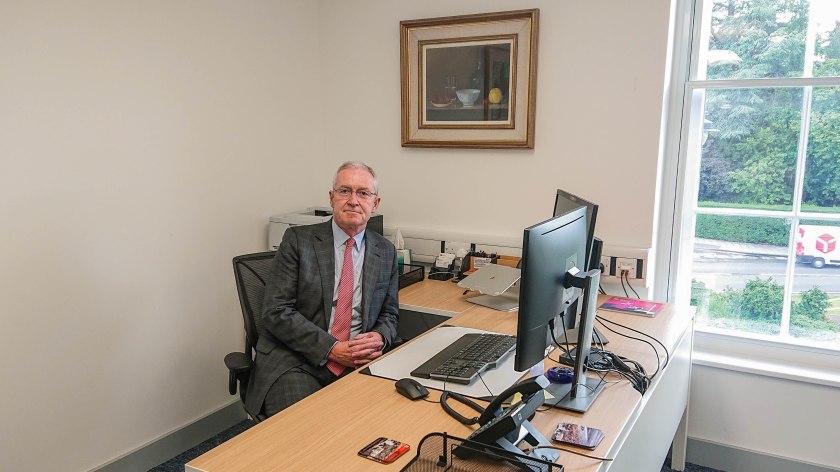
We started this Crunch journey back in June in Professor Brady’s Office, on the University of Bristol campus. Ironically, this first Crunch has no Brunch involved due to the busy nature of a Vice-Chancellor. Nonetheless, his brain has most definitely been crunched!
Professor Brady, could you tell us a little bit about yourself – your name and what you do on a typical day?
Hugh Brady, President and Vice-Chancellor of the University of Bristol (UoB). I’m a physician scientist, graduate of University College Dublin (UCD) Medical School, who then went onto general medical training in Dublin and specialist training in clinical nephrology (kidney disease transplantation dialysis) in Toronto. I spent most of my academic career at Harvard Medical School where I developed my research career, before returning to UCD as Professor of Medicine and then led that University as their President for 10 years before taking up the Bristol role. What’s my typical day like? Well the one thing about a VC’s day is that literally every hour is different because you might move effortlessly from a meeting on the curriculum into a meeting on student support, into a meeting on an international research collaboration, into a meeting on the Temple Quarter Development on the new campus, into an Alumni event or even inaugural lecture – so probably one of the most varied jobs in the world!
Plus of course the odd hour for a student interview here and there! Now normally this interview would be conducted over a Brunch, but given your very busy nature, we shall settle for asking what you had for breakfast?
Very little! A cup of coffee and a bowl of cereal; I didn’t have time for anything else. We had an alumni event last night in London and then another for some very philanthropic alumni this morning.
Now on your background growing up – you were schooled in Ireland, but what was your family environment like?
I have three siblings. I’m the oldest in what covers a 10-year span, in what is a very typical Irish family (one parent from Dublin; one from rural County Wexford, sunny side south of Ireland), and both very passionate about education which of course, I suppose, programmed me towards university after secondary school. I wanted to be a vet up until I was about 14, and for some reason overnight decided that human medicine rather than veterinary medicine was the more appropriate career for me, and possibly influenced from my grandfather who was a GP.
So, you’ve had quite a few other successful family members in the academic world as well.
Yes, my grandfather was a GP, although one of my uncles being a Professor of Chemistry at Purdue University was also an influence.
A vet until around 14. Going back to 12-year-old HB, did you ever imagine being who you are today, back then?
Never! In fact, I’ve only ever met one student who wanted to be a VC when they grew up. I don’t think I even knew what a University President was.
And yet here we are today! Now, what has been your key motivator throughout tough times, as I’m sure you’ve had many throughout your various universities across the world?
I think that motivation changes depending on what stage of your career you’re at. The earlier stages of my career (clinical medicine/having the privilege of caring for the sick and in the clinical speciality of nephrology) there was a particular satisfaction, despite being very challenging, of managing critically ill patients with multi-organ failure in ICU. Here, you realise how close the frontier of knowledge actually is, and how little we know about common diseases and because of that, how inadequate our therapies are. At an early stage, it definitely helped me to pursue a career in research which I enjoyed and particularly developed in the States. Later on in my career, after I returned from the US to Dublin, I had an opportunity by virtue of a fascinating Irish-American called Chuck Feeney, who donated hundreds of millions to the Irish Government to develop capacity in Higher Education and Research, providing the government matched it; one of the key rules of the game was the building of large, multi-disciplinary collaborative programmes. I was asked to meet UCD’s effort in that programme, and from that I suppose, I started to understand that I like building institutions, working with people building lasting programmes, and that ultimately lead me to university leadership. I think depending on where you are in your career, different prompts take you through to the next step – not always linear, I think that’s really important for people to understand, increasingly so –
So, your mentality has changed since your 18 year old self. What did you think was important at the time, and has this stayed true today?
Yes it has. It’s hard to think back to 18! I started medical school three weeks after turning 17, so by 18 I had spent a year studying and was excited by the prospect of entering the clinical arena the following year. But I was also getting a sense that I was very interested in research through summer projects, and electives – that, unknowingly, set me on a course for a career in academia.
And contrary to that, was there anything you thought that was irrelevant at that age and has since become really important to you?
Medical schools back then tended to be relatively independent entities, and you develop your medical career without interactions with other disciplines (and that is now changing completely through collaborative work). So, to look back and say what could I have done differently? Interact with humanities, engineers, and social scientists. That collaborative culture came later on in life for me.
I think it’s safe to say everyone faces adversity. What were your most important failures to help you become who you are today?
I think of them as major challenges rather than failures. One formative event was leading an institution through a financial crash, in that I was UCD President from 2004 – 2013. In the first five years, a period of unprecedented investment in HE and Irish research (nobody anticipated you would, in what was a 10-year term, have a crash with the Irish property bubble bursting) – so you had to really deal with adversity and uncertainty on a huge scale. That was unexpected, but it prepared me for the uncertainty that now exists, whether its Brexit, coupled with the review of HE funding, the unhelpful immigration policy or the broader uncertain geopolitics around the world. It’s not as dramatic as 2008/09, but that period definitely helped me to lead an institution through times of uncertainty.
They say uncertainty is now the new certainty, which leads me on to asking: as VC, you have many stakeholders to report to (students, government, faculty, etc) – how do you prioritise these when deciding?
Formally, the Board of Trustees. But you have a moral responsibility to all stakeholders; that in turn was instrumental in both UCD and in Bristol, right up front trying to agree a framework and strategic plan for the University through a consultative process with all stakeholders. That has been very valuable to try and get as many people as possible on the same page, in terms of the overarching ambition for the institution and trying to agree the difficult investments to get to that place. I’m a great believer in having a strategic plan. It is just a road map, but it needs to be constantly probed as the context changes, and change itself, if necessary, especially as universities are complex ecosystems with many cultures and communities all working together. Dealing with 25,000 students on a daily basis can be challenging, but also the nature of conversations varies with each faculty.
You were recently with alumni. How do you balance all this and what do you do to get away?
My wife would say I probably don’t balance it very well! It’s gratifying on the one hand, because every hour is different (0730 until most evenings with some university event). When I meet fellow VC’ as part of the Russell Group, the 24 elite research-intensive universities in the UK, one thing we often talk about is somehow trying to maintain some type of balance, but it is very challenging. In terms of relaxation, I enjoy golf, but I don’t get to play enough of it. When I’m on the golf course, my expectations are low, so I enjoy the scenery and company!
In your view, what are the biggest barriers of success facing the youngest generation?
I’m always reluctant to speak for the young. Talking to students, the theme of uncertainty pops up quite a bit due to constant change; they are aware they’re training for jobs that don’t yet exist and so their ability to learn throughout their lives is critically important to change track many more times than we ever did. Uncertainty needs to be grappled with in a way that we didn’t. You hear great stories from marches in the 60s, but actually students nowadays care much more about the planet and have a much more nuanced view than we ever had, so they’re more engaged but this can bring anxiety and stress. Social media, which has so many benefits in terms of building communities but is challenging in areas such as the ‘likes’ culture where people are constantly being judged in a way that we never were, and that culture of perfectionism must be quite stressful.
Not that you’re old yourself, but what advice would you give your younger self?
I don’t have major regrets. I’ve been privileged to enjoy my career, but we must remind ourselves constantly that it is not everything.
On that of academic-turn-physician – what lead you to start that change.
Appreciating how little we know about disease causation led me to pursue research in addition to my clinical practice, and with that, teaching. You’re juggling good quality clinical practice, good quality teaching, and good quality research. Invariably as you progress upwards, you’re adding a fourth of leadership and administration. From a workload point of view, it’s challenging yet rewarding.
What has been most challenging during your University of Bristol VC role?
Multiple, on uncertainty. We have ambitious plans, but we’re trying to deliver them with one hand tied behind our back (that competitors in the US/Asia don’t have) with Brexit (recruitment/frictionless access to help compete), and the Augar review of HE funding (threat of reduced funding from lower tuition). Adding this to immigration policy, most other countries allow two years’ work entitlement post-graduation whereas we’re stuck on six months. Combined, these three really do tie one hand behind our back.
Have you thought about what UoB could be like in the 22nd Century, with all the ambitious plans?
No! But I would be very surprised if the University doesn’t exist and isn’t thriving in a vibrant part of the regional society, but equally contributing in a very significant way to the UK economy. Why? Well the two longest enduring institutions are The Church, and universities (almost a millennia). And, given the increasing importance of knowledge to society/tech/health, I can’t see this changing. What the size/shape/structure looks like is bound to evolve and I have no crystal ball!
You were quite fortunate to realise the value of academia, as I’m sure many Bristol students do. Do you think University education should be a right or a privilege?
Education should be a right for all. Then, you have to decide with HE what the appropriate balance is. Many developed countries have between 50-60% going on to HE, but then if you look at Germany as an example, you have technical training that is valued and prized in a way that we don’t here, and for many students that is the path that they choose and offers them a very good career and income. But I do think that is absolutely the case for everyone in the workforce, and indeed everyone in society, lifelong learning has to become the norm: the opportunities are so great, but equally the challenges are such that we need to learn to roll with the punches that we face every day in the modern world. Education is such an important part of our ability to thrive in that ever-changing world, and particularly with times of uncertainty.
The role of Execs/CEOS/those in power is often argued in the media as ‘overpaid’ and the contribution that they bring to a company isn’t necessarily worth all that they’re being paid for, especially as the rise of inequality between the lowest paid worker and those at the top. What would you say to someone that argues they’re overpowered and overpaid?
Of course, if you look at different sectors, what is overpaid in one sector is dramatically different from what the pay might be in another sector. What we must do, especially university leaders, is convince the wide range of stakeholders that you’re adding value to the institution, and that you’re providing clarity in terms of vision and ambition, and a compelling strategy to get to that place. All VC’s are, and should be, conscious of the fact that we are just custodians, or stewards, of wonderful institutions and traditions. We take them over for a limited period of time, develop them alongside colleagues, students, staff, and alumni as best we can over that period of stewardship – and then we hand them over to the next generation of leaders. What is certainly exciting is how even more important universities are becoming in society and city regions; Bristol is a great example of that. We pride ourselves in not just being a wonderful education and research institution, but actually as a civic university, whether through our innovation and enterprise activity, volunteering, or just the extra university life of our staff and students, they are integrated into every facet of the city and the city region and are so integral to its success – the opportunities for universities to go beyond their traditional role and be the drivers of health and wealth of city regions – which really excites me!
As a custodian, when do you think your role at an academic institution would be completed?
I don’t think it’s ever completed! Bristol has existed in different shapes for almost a century and a half now, so my leadership is but a small part of a story, and I think what we’ve done is set a framework for the development of the institution for a limited period of time. We do everything we can to ensure that there’s buy-in from all the stakeholders, and then we work to deliver on that. It’s very much a journey that I came into four years ago, and if I can leave it in a better place, then others will continue that journey. Yes, it’s a leadership role but it’s also a stewardship role.
Just to conclude, would you say you’re successful in your own terms?
I think most VC’s would say ‘successful’ is such a loaded term. I’m proud of the achievements and progress we’re making at Bristol, but equally I’m very ambitious for the institution and areas where we are on a path but where there’s a lot more work – there’s always so much more that we can do. I can’t ever see myself saying my job is complete, but it’s a privilege to be a part of it.
That’s this first Crunch complete. What are you up to for the rest of today?
We have a VC Fellowship event to bring in some of the best young researchers into our institutions, so in a way they’re the future of the institution. I have the privilege twice a year to have dinner with them and hear what they’re up to. When I do, I come out thinking that the future of our institution is in very good hands!
 The Brain Crunch Brunch
Well done Simran. Amazing interview.
LikeLike