
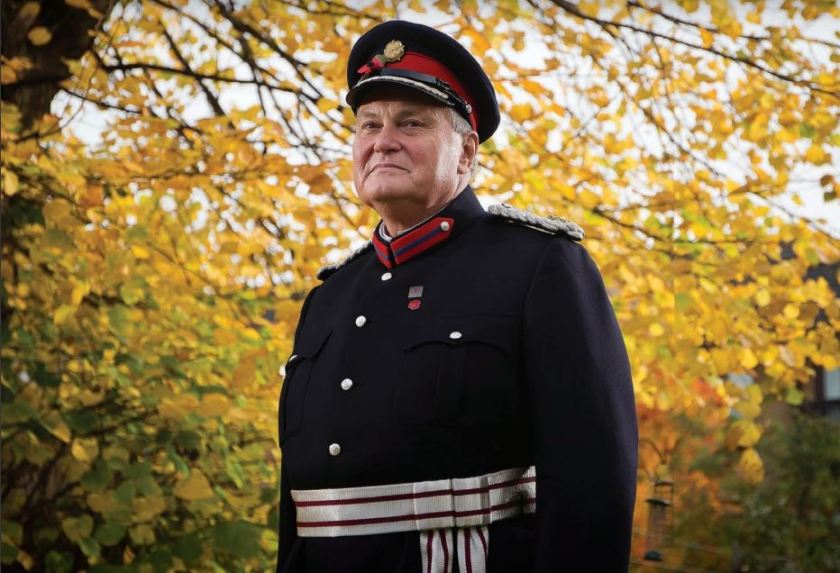
John Barber has held the Deputy Lieutenant role for the London Borough of Newham since 2007. Apart from keeping up with his own vast property portfolio, he’s also a Chief Executive for a charity in Newham, and has been for over 20 years. I caught up with him over brunch in the summer of 2019.
We’re in Café Mio in Epping,and I went for the full English. What did you get for today’s brunch?
One slice of beans on toast, one slice of cheese on toast, and tea!
Can you say your name and what you do on a typical day?
I’m John Barber, Chief Executive of a charity in Newham and Deputy Lord-Lieutenant for The London Borough of Newham. My typical day involves getting to the office about 9:30, which gives my staff enough time to gather through the rest of the work, and then I can interfere! I proceed to have 2 to 3 meetings a day, dealing with things relating to the elderly or the various properties that either the charity that I’m CE of, owns, or relative to my own property portfolio. Most days of the week, I go into The City for a meeting, and three times a week involves part of the day as my Lieutenancy duty, either uniformed or morning dress.
What’s your personal background? Family life? Huge aspirations to be who you are?
I was born in Ilford, I have a sister who’s 7 years my elder. I went to school and hated it beyond belief, as do many! My father was a governor of the school, and it was agreed that if I could pass my exams (due to take at 16), I could leave earlier; I took them at 14 and 10 months, and left the school at 15 and 2 months having passed everything that I needed to pass. I then went to work for my mother’s family and ultimately became a board director of a what became a public company. Since I was tiny, I wanted to be involved with property – but that’s probably due to the fact that all of my uncles were involved in property, and always had wonderful cars, and I thought that was a wonderful way to get there. I never wanted to become a timber merchant (which is what my father was) as I had no interest in it. My mother then died when I was 16, and father died when I was 22; an early termination of parental involvement.
Your mother had her own business; do you have any other successful family members in your eyes?
Yes, generally, my father’s family built most of Islington and that general area. My father’s brother was a bank manager, and my mother’s brother was chairman of 5 or 6 public companies. When he died, he left the biggest estate ever published, having started from nothing. My mother’s other brother was incredibly involved with The City and had a number of businesses with his wife’s family – she owned numerous department stores throughout the whole of England, so I was lucky I had that element of involvement.
You definitely inherited that drive to get where you are! Going back to your 12-year-old self – did you ever imagine being where you are today?
I knew precisely what I wanted: have a property in a nice place, have a nice car, and have the lifestyle I saw other people having. For arguments sake, after my mother died, we’d go and spend Christmas with my mother’s two brothers, and they had live-in staff, chauffeurs, and my intention was to have the same thing. Fortunately when I got to 40, I had. Pure luck!
Well they do say luck and hard work go hand-in-hand.
Property is an ever-evolving market, especially in London. And along with your Lieutenancy, is there anything obscure that people don’t expect?
With the property world, everybody assumes you’re going to make a fortune by buying property. When I set up my own estate agency, I was told I was mad because I was going for a very affluent area (part of Barnet, into the East end of London), and the thought was that I would fail very quickly, which I didn’t, and that gave me the encouragement. It showed me a different side of life. With people, I realised at a very early stage of life that you should treat everybody equally. Interestingly when I set up the estate agency in Manor Park, one of the other firms who were very big (Asian owned), came and saw me and said “the easiest way to do, is to treat these people with disdain, don’t be nice. Just get their money”. I took it the complete reverse way: we treated everybody nicely, we would make them a cup of tea, and sit them down. Within 2 years, the firm that was large had disappeared, and I had wiped them off the spot. It gave me the inclination that I had been called upon to go to Mosques to sort out disputes, sometimes judge things and give an opinion of how I’d do things. I was always called Mr John, “please Mr John, tell me what you think”, and that was one of the things that lead to the involvement with the Lieutenancy; the charity I run tries to help deprived people, which 9/10 times are the elderly who are the Cinderella of the world and have to fight their corner. With the lieutenancy, I’ve never looked to have anything else. Yes, when you finish you get something but I’ve done it to help other people. When I chaired Carpenters School we had major problems, but the moment I got the Lieutenancy, we wrote the same letter I had written 20 times before and that brought a response and issues dealt with, thus making all the difference. I believe you have to put back into, what comes into the world.
Why is it you think the elderly are perhaps so neglected these days? Especially with care homes.
Sometimes they’re forced into a nursing home. Years ago, families were around to look after somebody, nowadays our charity has 50 residents and some of them haven’t seen their children for 4 years; the only time they see them is when they die and the family comes in searching for the money. I watch the elderly as often they financially struggle to make ends meet, because even if you get pension credits, you’re on an income of £150 a week. How you live from that is impossible. There needs to be more put in to help, especially in somewhere as diverse as Newham.
You lost your parents at quite a young age – what has been your key motivator to get through these incredibly difficult times, especially at the age of 16?
Fortunately, I can’t really say I’ve ever been depressed in my life, and I’ve always known what I’ve wanted to do (whether it’s right or wrong). My motivation is: if I want to do something then I will do it. Where I used to live in Epping, a house in my garden came up for sale. I got a phone call whilst on holiday and agreed to buy it, but didn’t have enough money (well I didn’t have any money!), then worried about finding the money when I came home.
Then when you were around 18, what did you think was important at the time? And has that changed since?
Achieving qualifications. The realisation that when I was at school, I was doing what I had to do to get good exam results, but if I wanted to achieve something further then you needed qualifications. When I was about to leave school, despite having a job with the family, you had to go to the job centre. They offered me a job shelf filling in Tesco – that was not what I wanted; when I told them that I was going into property, they acted as if I was mad. But the difference was once I achieved qualifications as a chartered surveyor, and you can go forward, which is what drives you to do it. I didn’t want to live off the state.
Not many believed in you, and hence faced adversity. What were your most important failures to get you where you are today?
Times are often hard. I had a business partner who went bankrupt and I’d guaranteed her overdraft for £4m with the bank, and they wanted me to repay. I didn’t want to give up what I had, so I had to find a method to be able to do it. I gave up my home, 25 shops, 14 residential properties, and pay the bank back £8000 a month for 5 years. I used to get up at 3am and had a stall in Portobello Road. On the Sunday, I’d get up at 5am and do an antique fair in London; I could make enough money to live and pay back the £8000. Holidays hadn’t even entered my head as it just wasn’t feasible, but to be fair, my uncles had houses that I could stay at. The most important thing was to keep what I had as I didn’t want to give up everything. I collect a lot of art, and that would have cleared what I owed but I did not want to give it up. Even now, I bought a picture for £260 and is currently worth £150,000 – but I wouldn’t get rid of it as I like it! As simple of that.
How did you survive on such little sleep? Asking on behalf of a friend…
You adjust your life accordingly. I lived in a rented flat, and the rental was quite high but it had a garage. Subletting this paid half the rent, and you learn quickly how you can sponge off of friends for meals as you have no choice! You can’t have 10 people for dinner as you simply cannot afford to do it.
Since then, you’ve managed to enjoy your home life a bit more. Did you balance work and home life?
I probably have too many things that keep me away from home too much. Last year, I had 110 duties for the lieutenancy; this year [as of June 2019], I’ve done 100 already. Plus, City life, and being more sensible as you get older! I now make a point of going away in the end of July until the start of September. I head to a house in Spain and Ireland which is restful.
What does your City life actually entail?
I’ve had Freedom to The City of London since 1978 – both my mother’s brothers were liverymen and our family had been involved with the Blacksmiths Livery company since 1725; the basis was that I’d be involved. I got asked to join The Court, be Prime Warden which was daunting (although now a speech in front of 350 people is a piece of cake, at that time it was disastrous. I didn’t realise you don’t have to do speeches a certain way). I’m a founding member of another livery company, trustee member for another, and you end up in spirals. The new Sheriff just elected, I’m on his Shrieval Chain committee, I’m on another one too and your whole life is actively taken up. If I wanted to, I could do an event 2-3 times a week, but I stick to one every 2 weeks.
You were introduced to The City but have gone way above and beyond an introduction. What made you pursue this?
Once you get involved and people realise you’re capable of doing something, they then want you to do more. I was asked if I wanted to stand as Sheriff, which means you lose one year out of your life and go to the Old Bailey to live, to undertake in that year about 200 to 250 events; you’re not living at home, running your business etc, and it doesn’t work (I’ve seen other Sheriffs do it but it becomes a displeasure as opposed to an enjoyment). I’m quite content although I may disengage myself as time goes by. Do these things as long as you want to, but then step aside to allow the next group of people to take these things on.
Talking of the next group of people… You’ve helped multiple young and elderly people through various charities, but what do you think are the biggest barriers facing young people today?
A lot of young people do not necessarily understand the “voluntary” side. If you’re a volunteer for anything, people ask “what do I get paid as a volunteer?”. A lot of the time it’s regrettably that a lot of young people have expectations far too high for what their abilities allow them. Every person assumes they must be able to go to university or have a car but the fact of where it comes from or how to achieve it is absent. I’m on the knife crime panel with Cressida Dick and we watch some 14-16 year olds get involved with the drug industry so they can have a nice bicycle to deliver the drugs to somewhere, and feed their habit. By the time they’re 18, their life is finished in some respects as they’re so addicted to drugs. To change, we have to give the right guidance to young people to help them realise what they’re doing. We have to give encouragement and guidance as it’s very important; we watch even my neighbour’s children and how they can achieve and at 16, he’s very good at making a speeches which has given him confidence. His father may be a merchant banker, but he goes to a state school and they’ve made him achieve by his own abilities and not shove money at him to do so.
What advice would you give your younger self?
You have to work hard, achieve good results, and be sensible about what a starting salary should be. You can’t assume you’re going start at £50,000. A young friend is 25 and keeps changing jobs as he’s not at £50,000; he never will be as he doesn’t have the qualifications as he left school too early, he hasn’t tried hard as he’s come from an affluent family that have given him everything, but he doesn’t outperform. It’s about realising what your abilities can be. Don’t put yourself to work in a shop if you want to be an accountant – go and do the exams, even though you won’t earn any money, but you’ll get the qualification which is the most important thing.
Returning to education, would you have done anything differently?
Yes, I would have concentrated more. The reason I did any good was because I have a very retentive memory. I should have read more books! I had only read what I was forced into. Now I spend around £300 a month on books and magazines that I read, and have 2 rooms in my house so full of books that you can barely move. I still want to learn and keep my standard of knowledge up to the right level to be able to achieve.
Every day is a school day! What has been your most challenging role as DL?
Accept that whether you’re dealing with The Queen or whoever it is, that everyone is a human being. With the royals, they are absolutely relaxed but you are their ‘go-to’ person if they’re on duty and there’s a problem (say their lady-in-waiting isn’t there), then you have to deal with it. The most challenging was when the public refused to move even for security. I explained to Princess Royal and she said “I’ll put one of my looks on”. As we walked, people parted in a way that security and police had not succeeded. The rest of it, as awful as it sounds, is quite easy. You arrive, and you deal with ordinary people. I’ve seen the Duchess of Cambridge anxious and nervous, and Harry nearly in tears. At the end of the duty, when the public and cameras were gone, he came and gave me a bear hug! Some of my other colleagues may not have been able to accept, as it wouldn’t have fitted within their mindset, but I’ve never had a problem.
What about in the property industry and the other side of your career?
Probably when interest rates on mortgages were 18%: people struggled. It’s tough when you give a valuation, but people say “no, the house next door sold for X” but then when you’re the person that sold the house next door (and not for “X”), it’s difficult explaining about the asking price versus the actual amount sold. The other difficulty lies in when the buyer wants a 3-bedroom detached house, but what they can actually afford is a 1-bedroom flat.
Wow, it’s unheard of for people of my age to hear anything above a 1% base rate, let alone 18%!
What point would you feel as if your job as DL would be complete, if ever?
If you start at 50, you’ll carry on until 75. I’ve had it since 2007 and have been able to achieve that some groups now interact and get out of work with each other, who had previously never had any contact. With religion, it was that you can have the young Jewish brigade work with Gentiles (Muslims, Sikhs, etc.) as we’re all the same. There is nothing to prove but you still get an element of racism which I endeavour to get rid of whilst I’m doing the Lieutenancy. Sometimes there are comments that are totally unacceptable.
Dinners with royalty, ambassadors, and other senior people. How do you most efficiently manage your time? Any good habits?
Just be yourself. I go to the Easter Banquet where the Lord Mayor of the City of London hosts every Ambassador in the world. I’ve often sat between Syria and Iraq, Turkey and Greece, etc. and you just have to act yourself. Presidents and kings too, but if you get asked something, ie the Chinese president asked a question and you give an answer, which wasn’t what he wanted to hear, but give an answer around the context and approach it in a diplomatic manner; if you’re not diplomatic, you immediately have a problem.
What would you say to someone who would argue that the monarchy is overpowered and take too much of taxpayer resources, and don’t have a place in today’s society?
The same as I say to all of them… George I decided that he didn’t speak English, so he employed a prime minister. In return, the PM agreed with him that all the Crown Land (Regent St, Bond St), would be given to the Monarch, and from the Monarch, would be given to the government, and in turn would give them their allowance out of it. If you think, every member of the Royal Family costs £1.52 a year. However, if the Queen asked, she could have all of her portfolio returned to her and she’d have an income of roughly £9.5bn a year. Simply put, that money is used to make things better; it’s the same with The City of London – they derive big income within The City, but they also maintain and run Epping Forest, and have City Bridge Trust which gives away between £18m to £50m a year, every year! You have to look at where the income derived from, and how it’s benefitted. The Queen gets (for the whole family), £132m vs £9bn… A slight difference.
Going back to The City – on the topic of diversity: traditionally there’s always been upper class white males. Are traditions ready to change?
It is changing. I think those days are disappearing. For arguments sake, there is an Alderman currently who is Asian; he wants to become Sheriff, and ultimately Lord Mayor (with me sitting on his committee). I know this man very well, but he’d be doing it for the wrong reasons. When I asked him to do something for charity, of which he wasn’t very helpful of, he asked “how long before I get a knighthood for doing this?”. You have to realise if you do anything within The City, or wherever for that matter, you’re doing it for the benefit of others and not the benefit of you.
Being Master of the Guild of Freeman last year cost me around £50,000. It isn’t subsidised by any third party. We raised for charity… £50,000. But if I had not put my own money into varying things, we would have made nothing. I’m lucky enough I can afford to do it, and if I couldn’t then there would be a major problem. If you become an Alderman or Common Councillor, it’s not just for you, but for everybody else! It’s very hard. I’m Chair of the Council here in Epping, and people assume you do it for the money – but I don’t take the salary. Very simply I do not want or need it. Yet people still don’t understand sometimes someone can put something in to help improve this world, rather than for the salary. Similar to what you’re doing with the Sikh War Memorial in Bristol – giving up time that costs you nothing.
On that note of giving up, what have you had to give up to get to where you are today?
You have to accept that if you’re required to attend a meeting in The City, or a Lieutenancy duty, you have to be there – even if you have plans! Currently I plan my holidays around the Lieutenancy. You have to adjust your life to be suitable to other people. I have to do The Queen’s Award for Industry: I could have stayed away longer but I have to be back early September. There are already demands in place that are unrealistic! That said, Cee Cee is a transvestite that runs a youth group in Beckton. He witnessed a stabbing, and did amazing things including raising £13,000 for charity and giving a lot of his time to do so. I’ll arrange for the Sussex’s to go and help with his mission of educating those in schools about the dangers of knife crime, as it’s getting so bad and is so prevalent in Newham. It all involves giving up time and putting yourself out.
 The Brain Crunch Brunch
Wow! I worked for John Barber from 1998-2002 as manager of Daken House which was part of his remit as CEO
He really was a nice man to deal with and had a genuine interest in the elderly residents.
I am amazed to find out his background. Just confirms what hard work achieved.
Best wishes John. Not sure if you will remember me. I now live in the Philippines.
John Evans
LikeLike
Hello to John Barber
I worked for him as a manager of Daken House Nursing Home back in 1998 until 2002.
A genuine man who really does care for others. Hope may remember me John.
Very best wishes from John Evans now living in the Philippines.
LikeLike