
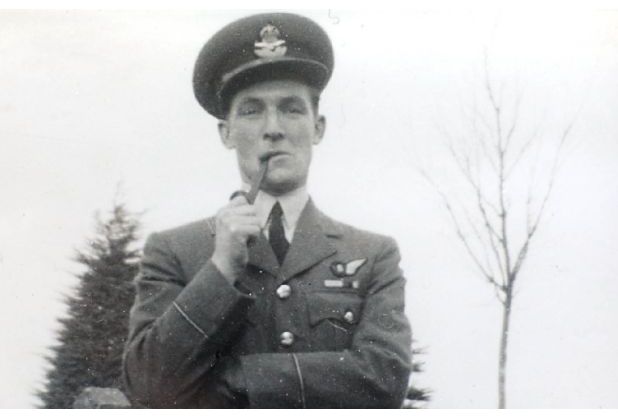
- [Pic: Torquay Herald Express]
On this morning of the 17th May 1943 at 3am, Squadron Leader Johnny Johnson was one of the 77 aircrew that returned from Operation Chastise, commonly known as the “Dambusters Raid”. This attack on the Möhne, Eder, and Sorpe dams in Germany was carried out by nineteen Avro Lancasters using the specially formed 617 Squadron, armed with the famous ‘bouncing bomb’ designed by Barnes Wallis.
This extended, exclusive interview with Johnny Johnson MBE is being released today to coincide with the 77th Anniversary of the catastrophic raid.
Disclaimer: this interview was conducted at Squadron Leader Johnson’s residence before social distancing was in place. A dear friend, Josh Rowles, kindly offered to conduct this interview whilst I was away in Hong Kong.
Can you please say your name and what your main career was.
Johnny Johnson, retired Squadron Leader. My main career was in the Royal Air Force (RAF) as a bomb aimer, primarily with 97 Squadron and secondly by invitation from Wing Commander Gibson on 617 (Dambusters) Squadron. From those two postings, I met up with the Captain of our crew, Flight Lieutenant Joe McCarthy – an American in the Canadian Air Force, and a great character! 6’ 3” in height, and the breadth to go with it. When we met, I think I was perhaps a mere 5’ 7” looking up anxiously at his 6’ 3” but we seemed to gel from that moment onwards, and we stayed that way throughout the rest of the war, and after the war as well.
Being a ‘brunch’ interview, what did you have for breakfast?
Is that referring to the day of the Dambusters raid? Or today? To me, breakfast is not an important meal – it starts with a cereal of some description, with an Actimel, and some tea (which I’m capable of making myself, although I do not need to now I’m in this care home). My main meal is lunch, which I have at the restaurant in this establishment which provides excellent food.
Please tell us a little bit about personal background: growing up, family, school, aspirations, etc.
My personal background starts tragically: my mother died two weeks before my 3rd birthday, so I never truly knew a mother’s love. The only time I remember seeing her was in her hospital bed, when turning from the window I saw her in the bed, went over and kissed her and hugged her, and she did the same with me; that was the only time I remember seeing and feeling my mother. From then on, it wasn’t funny. Incidentally, I was the youngest of six children in our agricultural family, but my father… I’m not sure how to describe it, he was a very cruel man: definitely self-centred, you did what you were told, when you were told, and how you were told to do it. If you didn’t, for instance, if the strop he used to sharpen his razor (hung behind the kitchen door) came down when he wasn’t shaving, I knew where it was headed, somewhere across my back and that was it. Yes, I expect sometimes I ‘asked for it’ but by and large it was just the way he felt. We never got on at all, and it wasn’t a case of father-and-son’s love, but more father-and-son’s hatred for each other.
This occurred until I got my place at Lord Wandsworth Agricultural College, Hampshire, thanks to my elementary school headteacher. At first, my father said “no, when he’s 14 he can get a job and bring some money into the house” but the headteacher wasn’t very happy about this. In this small village we had a squire, so she went to see the squire’s wife and told her the story, and the squire’s wife went to see my father and told him his fortune in no uncertain terms, about how he’s ruining my life by not allowing me to have this benefit. My father said “ugh, I better let him go then” – what he was saying was that if he disagreed with the squire’s wife, the squire would make his life bloody difficult for him, which is how I got away with that one!
That was essentially the start of my life, and from then on became a question of good luck all the way along the line. I managed to pass my school certificate, and at that time I had the ambition to become a vet but my school said that I wasn’t good enough for matriculation, and so I went to the horticultural side rather than anything else, and I had the ambition then to become a plant master at a large London park (surprising about how that one dwindled out too, but there we are!). Then I went to Basingstoke working as a trainee assistant park keeper. I’m not too sure why, but that was when I felt that I ought to be doing something about this world war – I had a personal hate for Hitler to start with, due to all the bombing and so on. I wondered what to do, and people later often asked “why the RAF?”. Well, I’d seen a film on trench warfare of WWI and the Army didn’t appeal to me one little bit, I don’t like the water, so the Navy was out… and that left me with the Air Force. Strangely enough I didn’t want to be a pilot as I didn’t think I had the aptitude, but I wanted to go on the bomber side. I knew the captains of the bomber aircrew were responsible not just for the aircraft but also the safety of the bomber crew; I didn’t think at that age I wanted that sort of responsibility, so I knew I didn’t want to be a pilot. But the committee decided differently, and they recommended me for pilot training. Ultimately, I ended up in America, pilot training. We had our own RAF system, but under the American Army Air Corps (America were not in the war at that stage). It seemed more about getting out of it, than getting into it!
I could not stand the Army Air Corps. Their petty discipline, and sloppy marching really got up my nose. However, the instructors were civilians and different people altogether. I managed to fly solo, but my landings weren’t quite what they should be. My instructor said to me “I’m sorry son, I don’t think you’re gonna make it” to which I replied, “don’t be sorry, neither do I!”. A group of 10 of us marched up to Maxwell field (Montgomery, AL) and one of the instructions were that we were not to talk going into breakfast… so we sang Colonel Bogey. If you know it, you’ll know it’s not the type of song you’d sing in a public situation. Our senior member, a Flt Sgt air gunner, said “lets show these so-and-so’s how to march RAF style”. We fell in outside the dining hall, went back to ITW, and marched back to the billet at 160 paces a minute, with arms swinging; the looks we got were quite something. At least we felt we left our mark and something they’d remember for some time. Then it was over to Canada, then back home in January 1942. Having joined in November 1940, I was no nearer to fighting that war that I joined for. What was the shortest course? Gunnery. So I took that, and passed as an air gunner, and posted back to 97 Squadron as a spare gunner. Quite an inauguration into operational flying. They had just been reequipped with Lancasters and were looking for a 7th member of crew (the bomb aimer) and training him not too far from RAF Woodhall (Lincolnshire). I thought I would have a go at it, so I went on a bomb-aimers course and remastered.
I went back to 97 Sqn and after about 10 trips I was told I was joining this crew with an American pilot – my first reaction was “these bloody Americans again!”. Then I met Joe McCarthy and what a surprise: 6’3” and the breadth to go with it, big in size, big in personality, but as we learned very quickly, big in pilot ability; I had tremendous confidence in Joe flying the aircraft. As far as I was concerned, I never thought that I would not come back with Joe. We had around 30 operations in our first tour, and as we were coming to the end (after which you got a week’s leave and became more operational tour, or ground tour), my fiancé Gwyn and I had arranged to get married on the 3rd April… But I got posted to RAF Scampton (Lincolnshire) to join the new squadron on the 25th March and I was told the first thing “no leave” and thought “there goes my wedding”. But Joe took a set of crew up into Gibson’s office and his American style said “we’ve just finished our first tour. We’re entitled to our weeks leave. My bomb aimer is supposed to get married on the 3rd April, AND HE WILL GET MARRIED ON THE 3RD APRIL”. Now, you can’t talk to a Wing Commander like that, but what I didn’t know was that Joe had done part of his training over here with one of Wg Cdr Gibson’s training flights, so he knew what he was up against.
Let’s go back to 12-year-old Johnny Johnson, did you ever imagine being who you are today?
Going back to 12 years old, I never imagined being who I am today because of the influence of my father and how much it weighed against how much I wanted to do. Having had the privilege and opportunity to break away from that, then I think I could see a way ahead that was going to be good, and that was that. It was absolutely tremendous.
You do find the most difficult questions to ask, don’t you!
After a very full, dangerous, and exciting life, what’s been the secret to living until 98?
The first answer is good luck, inasmuch that through Joe’s ability, I always came back from operations. Subsequent service with the RAF was always to my liking. I made one mistake through my own fault completely: I refused a posting. I was on an officer’s administration course. When the course was finished, everyone else got their postings but I didn’t get mine. At that stage I had 5 moves in 15 months, which meant moving the family and the children, and their education. We already had to send our son to boarding school. Then my postings came through, and they gave me another 3 moves in a maximum of 2 years. I went back to my station, to see the AOC who said “Johnson, you realise this won’t do your promotion any good?” and I replied “I’m sorry Sir, but I feel I need more time with my family than what I’ve got on this posting”. I then got a posting at a recruit school in Bridgnorth (Shropshire). Within a month, I was promoted to substantive Squadron Leader. I think it was the beginning of a fine career, lucky to have good postings, and although I didn’t realise it at the time, it was good preparation for when I left the service.
What is Operation Chastise?
It was the low-level attack against the 3 major dams in the Ruhr: the Möhne, the Eder, and the Sorpe. Before that, a special squadron was formed (Squadron X became 617), and our first meeting was explained as we weren’t to know what the target was until much later. To be perfectly honest, Gibson didn’t know at that stage! All he knew was that we had a very special target in mind, we’d be going on to low-level training. As that went on, we had to be happy and able to do it with our eyes closed at night… and that was it. Op. Chastise first of all was a training exercise, which practised low-level flying, bombing (bomb aimers had to make their own bomb sights), and practise on a bombing range where poles had been erected, and also bombing practice on certain reservoirs in this country (Derwent Reservoir, Derbyshire was a major one as it had towers, which we used as sightings; a marker on the edge of the dam would tell you where a bomb had dropped in relation to the run). We went from there to simulated twilight flying, where the front Perspex of the aircraft was covered in blue sheeting, and the pilot and bomb aimer wore night vision glasses. One thing I could never understand was how we were supposed to map read over the North Sea, as one of the turning points was in the North Sea, and you had to be absolutely certain you crossed our coast at the right place going out, and you hoped like hell that you’d bring yourself back to the right place on the way in. On one of those trips, we saw a dinghy in the water with two people waving like mad. Joe instructed our flight operator to signal base and give them our position; they in-turn got in touch with the sea rescue people and were then taken back to their squadron. We had done something useful besides flying about at midnight!
We then went onto night-flying, which was a complete repeat of the daytime exercise and was basically daytime as it had to be in bright moonlight-night – we did it until Gibson was satisfied. We discovered later, on the Saturday night of 15th May in the Operations Room, the majority of the Squadron met Barnes Wallis for the first time, and he explained his development in what was known as the ‘bouncing bomb’. The bomb weighed 9500lbs, of which 6500lbs was explosives inside the bomb case itself, fused with two death fuses which would explode the bomb at a depth of 25ft. It had to be dropped at exactly a height of 60ft, backspun at 500revs a minute, and dropped when the bombsite was in line with the target (which we had no idea what it was at that stage). Gibson went on to explain it boiled down to 19 aircraft scheduled on the raid. He would take off with 2 others to start with, and head for the Möhne. Six others would take off in two 3s, at ten-minute intervals, and follow him to the Möhne; if they arrived and the Möhne wasn’t breached, they were to carry on the attack under Gibson’s authority. If it was breached, then they’d move on to the Eder and attack that. That took care of 19 aircraft. Five of us were briefed for the Sorpe dam, which had to be different: there were no towers so no aiming point, it was so situated in the hills that a head-on attack was almost impossible. We had to fly down one side of the hills with the port-outer engine over the dam itself, fly along the dam, and estimate to drop the bomb (which wasn’t being spun) in the centre of the dam. We hadn’t practised that kind of attack at all, and that wasn’t the end of it!
After briefing, we went for the usual pre-operational meal of egg and bacon, although egg was probably more powdered egg. Now was the time when where was some wag in the Sergeants’ Mess would call across to another crew member “if you don’t come back, can I have the other half of your sausage?” and that was the start of the evening. We went out to the aircraft and got our real shock. Ours was “Q Queen” and it had been an asset masterpiece throughout training; when it came to this night it decided it didn’t want to go and developed a hydraulic fault which wouldn’t be fixed in time for take-off. There was one spare aircraft that had come in that afternoon after being bombed up, and it had a compass fitted to offset the metal of the bomb against the aircraft compasses. In his anxiety to get over to the reserve aircraft, Joe pulled his parachute and bellowed behind as we went down to the aircraft. When we got there, the last compass wasn’t in the aircraft. Joe had a tremendous vocabulary, and I don’t think I heard him use the same word twice describing what he thought of the instrument people that hadn’t put it back. Fortunately, the Squadron had some spare. The Flt Sgt heard Joe say he wasn’t going to use a parachute, so he picked up another and gave Joe a compass card and pushed a parachute into the back. It showed me some of the cooperation between the aircrew and groundcrew on the squadron: there was a spirit where even the groundcrew went out of their way to ensure the aircrew weren’t subject to unnecessary danger.
What’s the toughest thing you’ve gone through as your role in the RAF?
It’s certainly not the Dambusters Raid – that wasn’t tough, it was exciting. It was something that went straight to the top of memory and will always be there – that was the most striking part of my career, without a doubt. After that, a couple of delicate situations. Before Joe’s crew, I was flying with an NCO crew up to North Germany. As usual it was smothered in cloud and you had no idea where your bombers were. We were just coming back from there and switched off oxygen (below 10,000ft oxygen was switched off), then there was a massive flash: complete pitch black and night vision was ruined and felt like we were going down. It appeared the Perspex had been burned out, and all that was left was a bit of the metal. My eyesight began to return, and we returned back. In the meantime, the mid-upper gunner had spent his time calling Colin the pilot to make sure he was OK. Eventually Colin said “they’ve all gone, I’m getting out” but someone came back in multiple RAF terms to tell him what a stupid so-and-so he was. Eventually we levelled out at 2,000ft. I have no idea what happened to the aircraft at that time, but that was the first one.
The second one was with Joe on the Dams raid: we were travelling south of Ham (Netherlands), at a right-angle to our track. Since we had no upper turret, the mid-upper gunner was in the front turret, and he asked Joe if he could have a go. Joe reluctantly replied, “alright then”. He opened up with 2x .303s… What we didn’t know was that this was an armoured goods train, and it replied with rather more than .303s. We knew we had been hit, we heard it, we felt it… but it didn’t appear to impede the aircraft at all. It wasn’t until we got back that the chief engineer had a right go at us for getting shot at the way we did. We explained that shot we heard felt it went into the starboard undercarriage, burst the tyre, then passed through the wing, and landed in the roof over the top of the navigators head – how lucky can you get?! We got away with that one…
The third one was again over a Berlin trip, coming back we lost our port-inner engine. Port-outer engine had had enough too, and so we had two starboard engines; I know you can trim for these sort of things, but you still need a tremendous strength to hold up against that amount of power on one side. And of course, pilot skill to keep the aircraft relatively airborne. Joe called “mayday” as we approached the coast, and RAF Tangmere picked us up. There wasn’t a single time Joe ever said “crash stations”, I presume because he wasn’t quite sure how the aircraft was going to behave on landing on those two starboard engines, but he made a perfect landing (of course!). Those were the three occasions where things might have been kind of different than what they normally were.
How old were you when you left the RAF? And how many times did you move houses?
42 years old! And trips… I did about 50. First was in 97 Sqn, then the Dambusters raid, and another 19 with 617 Sqn. The only reason I left the crew at that stage was because, Gwyn and I got married before the raid, after that trip with Gibson and she was expecting our first child. In April 1944, Joe pulled me aside and said “Gwyn must be worried stiff about when this child is going to have a father, or if she’s ever going to have a husband. You have to give her a break, pack it up now!”.
He made me realise I had other responsibilities at that time, other than just fighting the war. Reluctantly, I left the crew but only in body – spirit never left.
But in terms of how many times you moved houses… You lived in Cornwall, up in Scotland… Was that tough?
I lost count. Every time we moved, we moved as a family. The morning of a posting, we’d have a look around and try to find some accommodation. If none was available, then we’d go to a local hotel and Gwyn would look whilst I went out to work. Something always came about that was reasonably acceptable.
You’re most famous for your involvement with the Dambusters: How did this come about?
I’m now lucky enough to be the only survivor of the 133 that started; it makes me think firstly about how lucky I am to be here, and secondly about the 53 aircrew we lost on that night and the 3 retained prisoners. How lucky I was to survive that, but also the rest of my crew and the RAF, and the rest of my working career afterwards. I find I had to say to people “things that come my way aren’t me, it’s for the Sqn! I’m still representing the original 617 Sqn and I will always do so.” I think I was lucky, and honoured, to be on a crew that was selected for the Dambusters raid and that followed through for the rest of my operational career and subsequently on our ground-crew tours. Gibson spoke to Joe one day and said, “would you join this special squadron for one special trip?”. We were coming to the end of our tour with 97 Sqn. Books say that Gibson invited all the crews, but actually he didn’t and just selected a few. Joe had done some training with him when he first came over from Canada, and hence he was invited by Gibson, and agreed once Joe had spoken to all the crew. To me, it was a yes. Looking back, not only was it a privilege but an honour to be a member of the crew that took part in that raid.
Could you enlighten us on something you were never expecting when you signed up in 1940?
I expected to be a bomber pilot, and to fight for this country in response to Hitler’s fight against us, realising we had to win this war in order to keep some sort of freedom. I was lucky that the jobs I got were to my liking, and that they provided sufficient enjoyment and material businesses to improve my life generally.
Everybody faces adversity. What were your most important failures to help who you are today?
Refusing the posting and then declining any further promotion. It didn’t mean that I lost interest in the service, I still enjoyed my life, but I think I could have gone much further than I did. I don’t like to think about that, but I enjoy what I did: I enjoyed being able to have my children with me, the family with me, and family and service intermixed to a degree that neither interfered with the other.
It’s been answered very well amongst other questions, but how did you balance home and work life?
Basically, work had to come first. It was a question of making sure that sufficient provision was made for the family at the time that I was doing my work. That is what I was there for, it was my job, and it’s what I had to do.
What key activities do you take part in to relax?
Laziness! I spend far too much time in this chair, and I know I do that. I can’t convince myself to get up and do something much more active and I know damn well that I should be. The difficulty is in the convincing. Yes, I’m a stubborn old so-and-so in that respect! I find relaxation in talking. It’s become so much part of my life now. I said to the children recently that if I get to a stage where I don’t wish to go on doing this talking, you can send the box in as soon as you like, as it has become so much of my life! That, and family… and well, keeping alive. I suppose I have been relatively lucky that I’ve gotten so far with life. I’m looking forward to the next two years, after the end of November as it’ll be a centenary. I told my children at my 80th birthday party “you need to start saving now, as when I’m 100 I expect a decent present!”. I haven’t seen any sign of saving yet, and we haven’t got much longer to go.
What makes you different from all the people who have tried to do what you’ve done and failed?
God, what a difficult question! I guess the easiest way to answer that is to say that the motto of Lord Wandsworth Agricultural College (now just Lord Wandsworth College), in Latin which I knew but don’t care to embarrass Latin scholars by using the Latin pronunciation, is “perseverance conquers”. Looking back at my life, I’m amazed at the number of times in things that I’ve been doing that there’s some second motion saying “get on with it, do it properly” and that is what I put it down to. That motto being engrained into my mind, and never really left it. It’s worked out extremely well. I always say when talking to the younger group, especially the Air Training Corps (ATC), if you join the RAF, I hope you get the job that you want to do. Make sure you do it to the best of your ability, keep going hard at it and you will find you made a success of that job, and it will give you a much happier life than you’ll live otherwise; it’s well worth the effort of getting there.
What have you had to give up to get where you are today?
My wonderful RAF life. My wonderful wife (62 years of marriage): Yes, we had our differences, but we managed to sort them between ourselves rather than passing them on. The sort of thing which I find with Gwyn, life was wonderful, and I still think of it in that way. That was the greatest loss of my life, when uncle cancer decided he had more right to her than I had, and I was in a terrible loss, I really was. It probably made me closer to the children than I had been. Not that I wasn’t close, but it pulled us so much closer, especially with some of the grandchildren. But it’s family life overall more than anything else, starting with the marriage that I was in.
What advice would you give your younger self?
The only advice would be that whatever you have to do, do it to the best of your ability. Achieve what you set out to do, and don’t let it slide over your head.
Writing a book must have brought back many thought-provoking memories – how did you cope?
For those that wish to purchase Johnny Johnson’s autobiography, The Last British Dambuster: One man’s extraordinary life and the raid that changed history can be found online here at Waterstones and at many local bookstores in the UK and abroad.
Looking back, memories about Gwyn and our family hurt the most. Others, I find that I enjoyed life, I felt I had succeeded in life, and memories I try to treat as good ones. There are a few that weren’t quite so happy, but a minority. I look at the happiness of my life rather than the other side – it’s a far better way of living with the present.
With writing the book, I did not write it. I feel somewhat embarrassed it’s printed with my name underneath. I talked, and the ghost-writer put those talking’s together (who was an author in his own right), and I felt he did a brilliant job. Yes, there are some things which he put in, as far as memory is concerned, which I really didn’t want to remember. It started very much with my son and myself trying to do it, but that wasn’t doing anything for the book. We tried asking someone for a ghost-writer, and they said it wasn’t necessary, and that I should write it and send it to them. If it’s alright, they’ll publish, and if not then they’ll make suggestions.
Another group of publishers somehow came to hear of this book and insisted on it being a life story; so much has been filmed and televised about the Dambusters, but nothing new about it. And a life story is the way it turned out to be, and an amazing book at that. I was very proud and didn’t put it down from start to finish. When it came to the last chapter, written by my son, there were tears in my eyes with how genuine and serious it was. Not only is he my son, but my best friend as well.
With regards to the last part, I coped with difficulty, but realisation that it was all true. I think that is the important thing.
After getting your degree, have you ever used the privilege of an honorary doctorate?
No. I haven’t been asked to! If the university said, “would you?” then I certainly would. That honorary doctorate I felt was in response to my work with the mentally handicapped after I had left the service, something which to me was a career; 14 years may not seem too long but certainly long enough at that age! I felt that I had achieved something there, and that was building up some of those more-able people so that they could be returned to the community and live as normal community people. That was very satisfying and the most rewarding, and finest moments of my working career.
What made you want to teach post RAF?
Necessity. I had no qualifications for outsider work and acquired a wife and 3 children in the meantime, but I had quite a lot of instruction in the service, and I thought then perhaps I could teach. I applied for junior teaching, but I knew if I went to secondary modern school (assuming I passed), they’d have very different ideas of discipline from my ideas, and I knew my ideas of dealing with that discipline would be different from the authorities ideas, and I’d probably be out of a job more times than I was in it. I thought I might be able to persuade the younger children to look the way I wanted them to and thank goodness it worked out – not to start with, but after the first year, yes. Not first year because I started with 46C-stream, the lowest of the low at a state school. One time I remember hearing “I don’t know nothing about writing and English, but I do know my money Sir”; I discovered his father was a scrap merchant but that’s the sort of thing I dealt with. I felt going to private school to start with, it was OK as parents were paying for the type of education the children were getting. For me, I learned how to teach children that wanted to learn – and that was the beginning of my teaching career. I had 5 years of that, but I didn’t want to leave it.
Why psychiatric patients after? From a military background, how do you relate to the patients?
I had also had a part-time job on Saturday mornings at Rampton Hospital which was a special hospital for rapists and murderers who had been able to convince the juries that they had a mental problem, so the judge sent them to this hospital. I picked up a part-time horticultural job there. Then, the hospital persuaded the LEA to allow them to set up an adult education department, so I automatically moved up from junior education to adult education at this special place. I got quite a lot of satisfaction out of that, as I kept the same group of people generally teaching in the classroom. The one thing that was so different was security! You do your keys in the morning when you went in, unlock the door to get in, and locked it when you went through… for every door that you went through. They had to have staff in the class as well, who came in their uniform in case there was any trouble, secure the whole time.
With this horticultural project, I discovered about ten of them had become interested in what they were doing. I wanted to know what the possibility was of taking them to a garden centre. I went to go and see the head nurse, who told me “no” and what a bloody stupid idea it was. We argued for a while and in the end, he said “right, be it on your own head, but God help you”. I went back to my class and said “we’re going on a trip outside. If any of you misbehave in any way, I’ll have your guts for garters when we come back”. We went off, and the senior nurse said I’ll have to take staff with me, and I requested they do so out of uniform (which they did). In this garden centre, the group showed interest, and asked intelligent questions. Afterwards we took them into the local café for a cup of tea, and they still behaved themselves. When we got back to Rampton, the head nurse was waiting for us. I’m sure he was waiting to see how many hadn’t come back, but he said, “oh congratulations, how did you manage it?”. I replied, “with confidence” and that was the end of that conversation. In the meantime, my local hospital had decided they wanted to do the same. Once I taught the senior consultant psychologist’s two boys at the prep school, I got the job automatically. That was for 14 years and I had a wonderful time building that up. We managed to get three houses during that time. Before we moved the patients in, we went down to talk to the local people and tell them what sort of people were coming to live next door to them and explain why. Then we invited them up to the hospital, and it made life so much easier as everybody was accepted. In those 14 years, not a single person was returned to the hospital for any sort of misdemeanour.
People that have failed in this sector is because they’ve failed to understand the job they’re meant to be doing. They also haven’t worked hard enough to make sure they’re at their best advantage. People used to say to me “oh I couldn’t do that job, although I haven’t tried”. I think if one did try, you’ll find any progress these people make is far more rewarding than the progress children make in schools, and much more satisfying. This is a way people should look at this work more: it’s not how difficult it is, but what can we get out of it, what can we make of these people, and how can we help them prove their worth.
As a member of the Conservative party, and someone quite involved from a long time ago, how do you feel about the current situation? And Boris Johnson/Brexit?
Oh dear! Member of the Conservative Party ever since voting age, and still am. I find I thoroughly enjoyed the peers I spent time with, in Torquay particularly after I retired as Vice-Chairman (twice), as Chairman (once), and ultimately President of the Torbay Conservative Association. I have found I’m still looking for a Prime Minister who is thinking about the country, and not about the bloody politics. I go back to Churchill on this one: I know he was respected as the best leader of the country. I find it difficult to accept that due to his strike difference between him and Sir Arthur Harris (Air Chief Marshal in charge of Bomber Command at that stage). In particular, we come to the Dresden Raid, to which I said no as there’s no military advantage and all we’d be doing was starting fires. Churchill insisted that the raid went off, and it resulted in a complete annihilation of Dresden and gained a lot of international comment on why it had taken place in the first instance. Churchill then said, “it was Harris’s fault, he decided to do it”. He struck me as the sort of man that if he had an idea and was good, he’d see the top body in that key area and put the idea to them. If it was tried and came off, “it was my idea”; if it didn’t “it was your bloody fault for not doing the job properly”. It is difficult to find any of the subsequent Prime Ministers thinking about the country. Some have been better than others, but I think for now we have the ‘ace idiot’. I considered writing a letter to him when he was appointed saying he was a disgrace to the Johnson name, but I didn’t quite get round to it. It would be interesting to see the outcome of the next election, and it appears it may go the wrong way due to the increasing interest the Labour Party has produced.
What would you say to any young man/woman thinking of joining the RAF?
First of all, I fear for the state of our services at the moment. Heaven forbid we should go back to 1939 situation but if we did, we’re a damn sight worse now than we were at that stage. Goodness knows what would happen. I find that, what of the service I know, I thoroughly enjoy. As I look at my picture of the Red Arrows, that to me is the finest demonstration team in the world without a shadow of a doubt. There are all the other things too, such as the F-35, which I think is a first for 617 Squadron.
Make up your mind and apply for whatever it is that you want to do; I hope you be lucky, but whatever you get, make sure you do it to the best of your ability at all times and work at it until you achieved whatever it is you had to do for that particular job. I find you will have a much happier life under those circumstances. If you start moidering* about not being able to get things done, then life won’t be so happy. Do something about it! If unsure, make sure somebody knows you don’t know what’s going on!
I would encourage them to join. I talk to all the Bristol and West Gloucester Squadrons and I’m impressed with what the ATC have done, with the way they approach their training, the intensity with which they train, and how much they seem to put into whatever they’re doing with their lives. Those who go on to join the service will stand in very good stead, an excellent start to whatever they do.
I would add that if there’s any doubt in your mind that by doing this you are not going to achieve what you want to achieve, then don’t join. Don’t go in to moider about it but work about it and so it works well. Good luck to you.
*Moider: to be delirious, to babble; to wander about aimlessly, ramble.
Finally, you started your career as a Senior Non-Commissioned Officer (NCO, Sergeant), and you moved into the officer lifestyle. Which did you prefer, and why?
They were different, and you adapted to whichever style of life you’re in. I did enjoy NCO life for quite some time. I was commissioned in November 1943, for only 3 years – but I enjoyed that too! One of my biggest problems was that I didn’t drink at all. From around 9 years old, my father was farm foreman and during the lambing season he would be up all night. On one particular evening he had his bottle of beer, and I tried the dregs. Yuck!! It wasn’t the taste, but the smell made me literally sick, and it stuck with me. I couldn’t even go into a pub or the mess and so I didn’t drink at all and missed quite a lot of fun. It wasn’t until towards the end of the war, on leave in Torquay. Gwyn had disappeared behind a blackout curtain, and I heard “what would you like to drink Sir?” and my God she got me into a bloody pub after all! The smell didn’t seem to worry me, and I started drinking brown ale although that didn’t last long. Initially, if we had a hairy mess party, I could say to Gwyn “it was your fault dear, you started me!” … That didn’t last long either. I do think that perhaps around the time I went to that pub, I started to lose my sense of smell…
Overall, I preferred the life of an officer, not because of the privileges, but it was a better life for the family. We could move from quarter to quarter with ease. I also found there was more to look forward to with the officer life, rather than as an NCO.
My name is Johnny Johnson, the last surviving Dambuster, and you’ve been reading the latest Brain Crunch Brunch!
This interview has been a massive milestone, and another prime example of a gentleman who’s excelled in his adventerous life. I’d like to thank Josh, Squadron Leader Johnny Johnson, and his daughter Jenny for making this interview happen.
Have you got any questions that you’d like to ask Johnny Johnson? Drop them in the comments below!
 The Brain Crunch Brunch
I have met mr johnson two years ago in the helicopter museum at Weston super mare, I am the administration officer for the sea cadet corps unit . I would like to know if he would be willing to give a talk about his service to our cadets when it is safe to do so.
LikeLike
Hi Judith- I apologise for the late response, however I also thank you for your message! Please feel free to reach out to Josh Rowles at Johnny100Years@gmail.com and he may be able to assist you further.
Best wishes,
The BCB
LikeLike
Seeking address to write to Johnny Johnson please.
Johnny was a friend of my fathers and contacted me when my father passed away. He also visited me in Australia some 38 years ago.
I am hoping I can gain a bit more from Johnny about my fathers experiences during the war to fill a few gaps.
LikeLike
Hi Terry – thanks for your message! Please feel free to reach out to Josh Rowles at Johnny100Years@gmail.com and he may be able to assist you further.
Best wishes,
The BCB
LikeLike