

[Pic: The Australian]
Sir Rupert Jackson spent 25 years as a barrister, whilst later being appointed to the Court of Appeal in 2008. Today we discuss Christ’s Hospital, challenging times, and his latest book.
Sir Rupert and I met at Il Castelletto, an Italian restaurant in Bloomsbury, just a short walk from the British Museum. There was a steady flow of people on this Monday lunchtime, and the restaurant was very accommodating to our needs. Our main courses took around 20 minutes to arrive, and were both very tasty.
We’re at Il Castelletto today for lunch. You have ordered the Sea bass (“Spigola In Salsa”), whilst I opted for the Spaghetti Arrabbiata.
Could you please give us a bit of an idea behind what you do, for those from a non-legal background? Perhaps some explanation as to what your key roles have been over your career.
Well, I started life as a barrister, and spent 25 years as a barrister. Initially as Junior Counsel and in the later years as a Queen’s Counsel (QC). At the age of 50 I went onto the bench, became a High Court Judge, and served for about ten years. I then was promoted to the Court of Appeal, and I served as a Lord Justice of Appeal in that court for another ten years. Finally, on my 70th birthday I retired at a ceremony which I believe you came along and attended.
Indeed I did. It was my first time inside the Royal Courts of Justice and was very exciting!
After retiring as a judge, I went back to the Barristers Chambers where I had worked before becoming a judge. I re-joined those chambers and I have practised there as an arbitrator doing international cases, generally sitting as one of a tribunal of three arbitrators, usually with other retired judges. A number of countries have set up international commercial courts staffed by judges from Britain and other well-recognised jurisdictions in order to provide a service for businesses coming into that jurisdiction; I also sit as a judge on the Kazakhstan Commercial Court. There are similar courts in Abu Dhabi, Dubai, and Singapore. Principally my work now is as an international arbitrator.
Was there any reason in particular as to why you chose Kazakhstan?
No. I was invited to join their court, and it happened to be set up the year that I retired from the bench , so I said yes.
We’re both alumni of the incredible Christ’s Hospital. Could you tell me a bit about how you found the school and any of your most memorable times at the school?
We are! I became a pupil of the school because I was presented by a Donation Governor who kindly made a contribution to the school, and so I received a free education there from the age of 10 to the age of 18. It was an exceptionally good education. I am very much indebted to the school, for it enabled me to get a scholarship to Cambridge. I would just add, for the benefit of the readers, that many pupils from Christ’s Hospital go on in later life to become Donation Governors and to present a child who will have the benefits that they have had. In my case, I became a Donation Governor when I was a QC. I presented a child having made a selection from a number of applications. That child went to Christ’s Hospital at the age of 10, did very well there, and I have kept in touch with him. I provided such assistance as he sought over the years. He is now a doctor and we meet from time to time. My wife and I will be attending his wedding shortly – he also came to my 70th birthday party with his fiancée. It’s a very good system. This tradition of supporting someone from the next generation who needs assistance ripples down the generations.
Incredible, as it has done for almost 470 years.
So, the Court of Appeal was a very interesting time. Again, you were at the top of the court system and must have been put into some very tough situations with difficult decisions to make. Can you tell us about one of the toughest situations you have been in?
Off the top of my head, probably the most difficult case I encountered was a few years ago. On a Friday afternoon, an appeal came into the Court of Appeal concerning the Epsom Derby, which was to be raced the following day, on the Saturday. The jockey, Kieren Fallon, was said to be in the breach of contract with Client A to ride a racehorse on the day. Kieren Fallon had gone on to decide to race a horse for a different client B. Client A couldn’t force Kieren Fallon to ride his horse, but took strong exception to him riding an alternative horse. Client A applied to the High Court for an injunction to stop that, the judge said that Kieren Fallon was in breach of contract, but would not grant any remedy. Client A then lodged a notice of appeal on the Friday afternoon which reached me at about 1600, clearly requiring an urgent hearing and decision. I sat with another member of the Court of Appeal to hear the argument. We started at about 1800, finished the hearing at about 2000 or 2100 that night, I then abandoned any idea of getting home, and worked most of the night. At 0900 the following morning, the Court gave its judgement; I had written the judgement overnight and we had set out our reasoning for an injunction restraining Kieren Fallon from riding the horse for Client B. I think by the time I read my judgment and made the order it was about 1100 on the morning of the Epsom Derby, which I think began at 1400. That gave everybody time just to find a new rider for the second horse, and the Derby proceeded in accordance with the Court’s order. That was a difficult case because my colleague and I were operating under tight time limits.
So I presume you didn’t make it to the Derby that weekend then…
I had to go to bed for some rest!
During that time as Lord Justice of Appeal, you conducted a review on the Civil Litigation Costs.
That happened at the very beginning. I was appointed Court of Appeal in October 2008; the Master of the Rolls, who is the head of the Court of Appeal summoned me to his room almost on the day that I was appointed. He said that he had a little job for me: he wanted me to tackle the problem of civil litigation costs. During the preceding decade or so, civil costs had been rising massively, the new-fangled conditional fee agreements and arrangements for after-the-event insurance were working very badly by driving up costs of litigation and distorting incentives, amongst many other problems. There was widespread concern over where civil litigation was going and the Master of the Rolls said to me that he wanted me to study the problem and get a grip on it. I was going to be given an entire year out of court, and he wanted me to look at overseas justice systems (which meant a trip around the world). He also wanted me to study academic research, to consult stakeholders generally to obtain evidence and to write a report proposing measures to promote civil litigation at proportionate cost. That was quite a tall order because views about how the system could be reformed differed widely. I divided the year into three section the first four months were investigation and preparation of a preliminary report; the next three months were consultation on the basis of my preliminary report; I then had a month for studying all the material that I had received and the last four months of the year were spent writing my final report. It was a year of frantic work. I had been given a deadline of Christmas 2009 to produce my report. I met that deadline and delivered my report to the senior judiciary and the Ministry of Justice on Christmas Eve of 2009. The report was published generally in January 2010 and it was implemented in 2013. I would just add that in 2017, I was asked to write a follow-up report, which I did, and that contained some supplementary proposals. The government announced in September 2021 that they are going to implement the supplementary proposals next year.
Moving to the next bit of life advice, what was the best piece of advice, solicited or not, that you have received on your journey?
The best piece of advice which I have received came just after I had started practising as a young barrister. As you may know, barristers have to eat a certain number of dinners in the Inns of Court, either just before or just after the time when they are called to the Bar. So, I was attending one of these dinners with young colleagues just starting at the Bar and towards the end of the meal, as is normal practice, the Benchers (the senior members of the Inn, generally judges and QCs) loftily descended from the high table to chat to the ordinary boys below. An elderly barrister deposited himself to our table and after some initial chat, he offered advice. He said: “young man, if you want to get on at the Bar, what you’ve got to do is to get up at the crack of dawn when your mind will be uncluttered and fresh and set to work immediately. You can get a lot of work done first thing in the morning which will set you up for the day, and you will find that a great asset in your career”. I thought that was rather good advice, so the next day I started it. I adopted the practice of getting up at 0530 every morning and doing a couple of hours work straight away before anything else. Throughout my time as a barrister, it was my practice to get up at 0530 and start work immediately; that was extremely good advice.
And on your work-life balance, did you end up continuing to work as late as what you would have done previously?
Sometimes I did have to work late into the evenings, but getting a large chunk done first thing in the morning was a great help, and I commend it to anyone else that is starting in law.
You’re retired from the Court of Appeal now, but how did you balance your work and life back then compared to still working now?
Whilst I was a barrister I did have to work very long hours (there is no avoiding that), but I did always take a couple of weeks holiday at Christmas, a week or two at Easter, and an entire month off in the summer where I would do no work at all. The system worked very well. When I became a judge, the pressure of work was not so great, and as a High Court judge I had very generous holidays (something along the lines of 13 weeks a year including the whole of August and September); the holidays were great but during legal term the pressure was fairly intense. Now that I have retired as a judge and I have become primarily an arbitrator, the pressure at work isn’t as great as what it was, but when I am in the middle of a heavy arbitration, then I do find that I am working 11 or 12 hours a day keeping up with the evidence, counsel’s submissions, and so on and so forth.
Are there any key activities that you take part in, as to help wind down?
Well, my wife and I have three children and six grandchildren and enjoy doing things with them. We have a large garden where I enjoy growing vegetables. I play chess and bridge with friends in the village, which I thoroughly enjoy. I also have always been interested into Classics; my degree is in Classics which I spent two years studying at Cambridge. I keep that up through reading and researching about history, so what with one thing and another, I am very busy!
Appropriately moving onto Classics, you have previously said how studying Classics can be an engine of social mobility. What would you advise to students that are making life choices currently?
If you are reaching the stage of deciding what to do at university and if there is an academic subject which you really want to study, even if it is not a vocational one, then I would recommend it. I much enjoyed Classics when I was a Grecian at school, which you and I will know means a ‘sixth-former’. I applied to Cambridge to read Classics, which I read for the first two years. Then in my third year I switched to law, essentially a vocational course. The great advantage of Cambridge over other universities is that you can do a split course, which enables you to pursue an academic interest for Part One, and a vocational career for Part two. Other universities do not offer that. My general advice is if there is an academic subject which you want to study at university, then do study that before you get sucked into whatever is going to be your professional career. On the other hand, if there isn’t a particular subject that you want to do, then the best thing is to probably study for your career immediately, such as medicine for a doctor or law for a lawyer.
Some great advice there. We live in very interesting times at the moment. Do you see any barriers or threats to the justice system across the world in the near future?
I think the biggest threat to the justice system internationally is state capture. In any properly functioning state which respects the rule of law, the judiciary needs to be independent: that means judges need to reach their decisions without any governmental influence, and if they make a decision which is adverse to a state institution, that decision will be respected and abided by. During my 20 years as a judge, I dealt with quite a few cases which were of concern to the government. On no occasion did any government department or minister suggest to me informally how a case should be sided. Any submissions made on behalf of a government department were made in open court, and dealt with to the best of my ability, in a reasoned judgment. An independent judiciary which is free from state influences is essential. It is also essential that the judgment should be honoured. During my time as a judge, I gave a number of decisions which the government disliked intensely, but the government abided by all of those decisions. If they didn’t like them they appealed against them as was their entitlement. If there was an error in the decision, then it would be corrected by a higher court, if not then it would be upheld. There has never been any whisper of state capture of the judiciary in this country. As one looks out across the world, there are an increasing number of jurisdictions where judges are under considerable pressure from the government either expressed or perhaps implied as to what they should do. A number of jurisdictions are under pressure to decide a case in a particular way, or where unpopular decisions may not be obeyed. I think that is a threat to justice internationally, certainly the number of states where state capture occurs is increasing. I would just add that the tendency now of overseas jurisdictions to set up independent international commercial courts is a very healthy tendency. For example, as I mentioned earlier, I am a judge in Kazakhstan. Shortly I will be going out to Kazakhstan in order to try a high value piece of litigation between a government department and an overseas company which is trying to do business in Kazakhstan. Now Kazakhstan is a former Soviet Union country. The court which I belong to is an international court, and we will reach our decision with nobody trying to influence us, save by appearing in court and making submissions through their lawyers. I think the development of these international commercial courts is a really good trend and I hope will tend to promote the rule of law across the world at a time when from other directions, it’s coming under attack
With these threats, do you think anything can be done in particular?
I suppose giving publicity to what is going on is good. Have you read the recent book by Bill Browder called “Red Notice”?
I have not.
That gives an account of the way judges come under governmental influence in Russia; I recommend that book. It is a very good book, but Russia is not the only country where this is liable to occur.
You’re a keen debater and have even judged debates of mine. Do you think debating should be included in the modern educational curriculum?
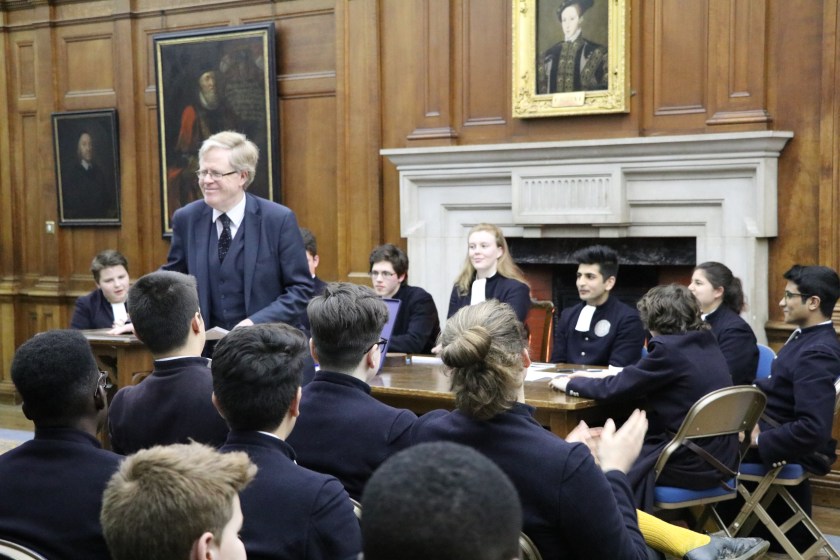
First of all, I think that public speaking is an art which is of a value – not just a matter of making eloquent speeches, but a matter of making concise speeches. It is important to learn the art of debating, but I don’t suggest that it should be taught (if it can be taught) in school or university. It is a very good activity to pursue on the side. There is an excellent debating society at Christ’s Hospital, of which you were a member and as I understand it, you twice appeared in front of me at debates that I was judging, and you won both times – so many congratulations on that! School is not the only place you can practise debating. All universities have excellent debating societies. Cambridge has a debating society called the Cambridge Union, and I was active in that. In my final year at Cambridge, I was president of the Union and I learned a huge amount about public speaking. I had the experience of presenting arguments and sometimes being shouted down and sometimes not. It toughens you up which is what you need, and speaking in the Cambridge Union was one of my most valuable experiences while I was at university.
Finally moving on to your pastimes, can you please explain a bit about your new book, and where your interest in Roman Britain came from?
I retained my interest in Classics during the 50 years or so since I became a lawyer. I have continued to read the classical texts. I have noticed how many of them refer to Britain, sometimes in detail: Tacitus, Dio Cassius, Ammianus Marcellinus, Herodian, and so forth. I decided to pursue my interest in Roman Britain rather more closely. I have written a history of Roman Britain called “The Roman Occupation of Britain and its Legacy” published by Bloomsbury in 2021. It is, I hope, an easy-to-read book laced with some humour as well to make it more readable for the general public. I also try to grapple with some of the interesting conundrums about the history of Roman Britain. Writing the book actually took me ten years, it has just been an interest on the side. From time to time I have visited Roman sites in Britain, always with friends or family members. So I have not been off on solitary excursions, but I have been able to visit a huge number of Roman sites and describe them in my book. I have read the classical texts and also read a fair number of archaeological reports. I gradually wrote this book as a little interest on the side. It is now on the market and I’m setting to work on writing another book, but I am not going to tell you what that is as it will probably take ten years to produce!
We shall keep tuned to find out about that. Now this interview has concluded, and we thank you greatly for your time in sharing your incredible journey you have had so far.
Sir Rupert Jackson’s book “The Roman Occupation of Britain and its Legacy” can be found at many bookstores across the UK and overseas, whilst a significant part of net royalties from the first edition will go to Classics for All, a charity that promotes and funds the teaching of classics in state schools.
Has this interview helped you to pursue your legal career? Or perhaps left you with even more questions. Feel free to write any questions below and we will try to get Sir Rupert Jackson to answer them.
 The Brain Crunch Brunch