
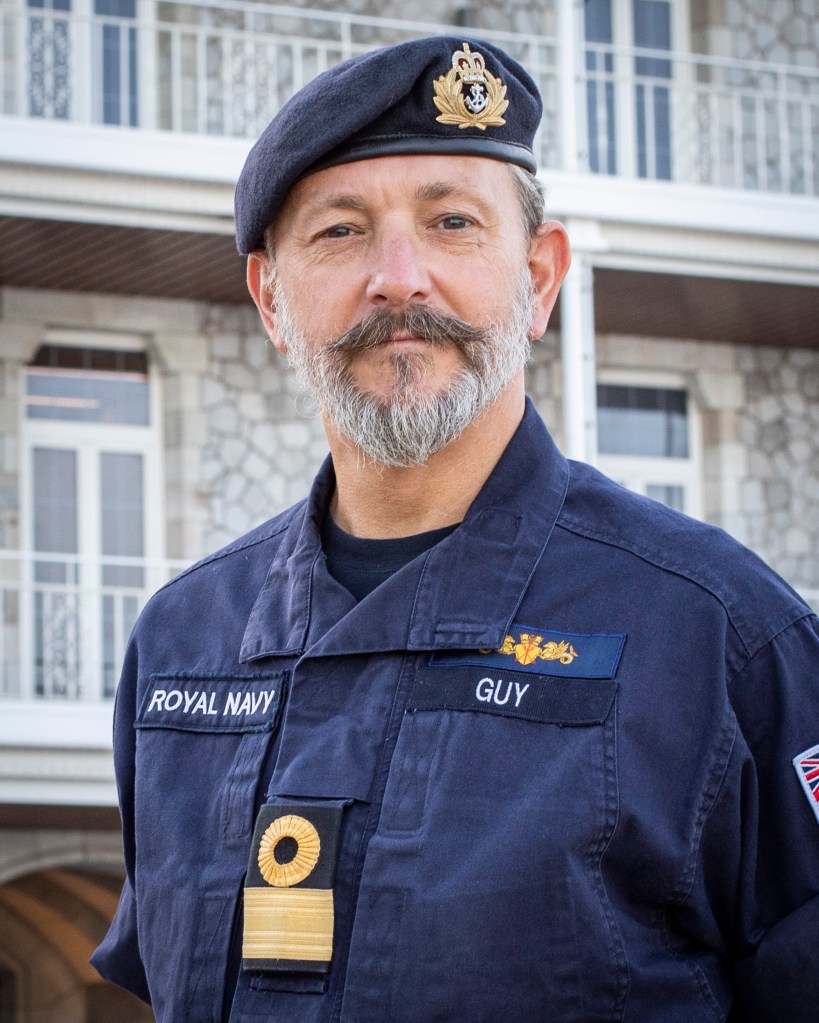
Commodore Tom Guy took up his post as Commander British Forces Gibraltar in June 2022. The UK Armed Forces have had a presence in Gibraltar for more than 300 years, and in this Crunch we caught up with Commodore Guy to understand his role in overseeing this British Territory.
We were hosted in the Warrant Officers’ and Senior Rates’ Mess at Devil’s Tower Camp, and both had fish and chips for lunch as it was Friday. We had gone for a Brain Crunch Lunch, which I don’t mind as it still rhymes!
For those from a non-military background, could you give us a bit of an idea behind what your role entails?
A Friday fish and chip lunch is a great Navy tradition. CBF – Commander, British Forces (Gibraltar in this case). We have about 1000 people in British Forces Gibraltar, of which roughly half are military and half are civilian. Our mission here is to support His Majesty’s Government in the UK and His Majesty’s Government of Gibraltar in demonstrating British Sovereignty, in support of Gibraltar. At the same time, providing UK defence with effectively a springboard for operations further forward. Most of that, from our perspective, is in the maritime domain, but not all by any means; we have an airfield which is a really valuable airbridge – we’re 1000 miles South of the UK and so that gives us a really good stopping off point for operations in Africa and the Mediterranean, very busy with traffic passing through, and hosting aircraft that come here to train. And by the way, also hosting Gibraltar International Airport, which is a civilian airport but lodges within our airfield. The maritime side is all about our Naval base, which supports UK government (Royal Navy and Royal Fleet Auxiliary) as they move through the region on operations. If you’re sailing a ship or task group from the UK, you can head South and start to conduct your integration training and then come into Gibraltar, give the crew a breather, top up on bullets used in training, top up on fuel, any of the stores that you may have left behind in the UK, reset, and then you are 1000 miles closer to where you want to be – predominantly East Mediterranean/Middle East and beyond. Increasingly as we forward base more of our ships and keep our ships at sea more as it is more efficient, we can also act as a pivot in the other direction: we can take units that have been operating in the Eastern Mediterranean, they will come in here, reset people/stores/fuel, and then they are ready to carry on operating in the Atlantic. There are some elements of resetting where we can also change out different types of ammunition as well. It is about demonstrating the Britishness of Gibraltar, and then supporting Britain’s wider global role for operating forward and reaching further, and more frequently, and therefore having greater influence.
A very important strategic base for everyone. Now, that must take up a lot of your time. Have you/do you have any roles outside of work that you enjoy or keep you busy?
I am a husband and a father, and I think the latter keeps me less busy than it may have done in the past – although I have been a dreadful father and gone away to sea a lot of the time, but they are clearly very important roles. If the question is “do I have any other professional roles?”, then no as being CBF is pretty all-consuming on that front.
Throughout your very long career that you’ve had, have you had a favourite aspect?
For the microphone, I am smiling riley at the phrase “very long career”! Yes, my favourite aspect has been the variety. The great thing about 3 and a half decades means a huge variety of jobs that I have done, and meeting a huge variety of people in different situations. I am really lucky that I have served in the Far East, North America, Europe, and in a lot of different roles. There are some constants, but the variety and changing roles every few years keeps it fresh.
For the record, I say “very long” relative to myself and my 3 and a half months out of training…
Well recovered!
What has been the most challenging role you have had?
I think they have all had challenging bits. It would be difficult to pick out a job as being much more challenging than another. I did lose all my hair when I was running Force Generation in Navy Command Headquarters at a particularly difficult time, so that probably indicates that it was fairly challenging at the time. The most challenging times were around people. Specifically on one occasion, around my boss. If it was anything else you could break a job down into bits and deal with them and work through it, but if you’ve got really difficult interpersonal challenges, then I’d consider that as the greatest challenge to get to grips with.
I have heard the saying that you do not leave a company, but you leave a bad boss, and they can indeed be very challenging at times.
If you do not mind, can we delve a bit into your personal background. What was life like growing up for you? Did you have any family from a military background?
I had a tremendous childhood and spent a lot of time on the water. My father essentially ran away from home and went to sea at the age of 16, but he went into the Merchant Navy largely because I think he didn’t want to go through the rigmarole of military training but rather he just wanted to go to sea. He was always very keen on naval ‘stuff’ and when I was young, we used to visit warships when they were in town and that sort of thing. For me, life was always about being on or near the sea, and that is what drew me towards the Royal Navy more than anyone.
So having that around perhaps inspired you to join the Navy? And how did that path come about – did you know from sixth form that you wanted to join?
I think I decided to join the Navy at about age 7! I didn’t think about it a great deal, until in my case, I got to O-levels, and I had determined that I wasn’t going to do any further studying beyond school and wanted to get into the proper world. When everybody else was fretting over their UCA/PCAS forms, I went and did my Admiralty Interview Board, and passed, so I joined the Navy straight from school at the age of 18.
Do you think that if you had to make that decision today, you would have done the same? Either in hindsight or today’s conditions.
With the knowledge I now have, I think it would be a tougher decision. Having done a bit of studying since then, I have really enjoyed it but at the time I was very happy with the decision. It meant that I got more hands-on sea time earlier, which I really liked.
Would you argue that helped your career, being able to spend more time at sea when you were slightly younger?
I think it is swings and roundabouts. Really early on, it was good to get hands-on experience. Later on, it would have been better to have the benefit of more education, although I’m sure my tutor at Dartmouth would be turning in his grave if he heard me say that! I didn’t really feel as if I had had a proper tertiary education by the time that I left Dartmouth – I loved the practical parts of it but it wasn’t quite the same as studying properly, which at the time I loved.
The family, and yourself, are keen sailors. Do you have any other key (or quay, depending on how you look at it) activities that you take part in to relax or for fun/sport? I also partly ask as you spend a lot of time at sea, which is work, but some people don’t like having hobbies that involve where they work.
Being at sea in a warship, and being at sea in a yacht is such a different thing. People frequently say it’s a bit of being on a “busman’s holiday” but it isn’t really. However the environment is the same and that is what I love. Having grown up with it and then being keen sailors (Katie and I met very early on and is also a keen sailor), it was inevitable that the kids would become keen sailors too, and they have been brilliant – both dinghy instructors and thoroughly enjoying it. That has been our uniting pastime, but we also have a thing for cars. Really that came from Katie’s side of the family, and it is great fun. We probably spend more time doing boating and sailing stuff than anything else.
Have you got a crown jewel in the car collection?
Here in Gibraltar, we are enjoying bombing around in Katie’s 1951 Series 1 Land Rover which is perfect for here!
Is that the one that received compliments within minutes of us arriving in the Mess?
Yes, that’s the one. We also have a couple of British cars in various states of repair back in the UK, including a 1971 Aston Martin.
Beautiful. I believe James Bond also took something similar to the Land Rover up The Rock?
I drove down that road the other day, and I was being told that the stunt double that they got to drive the Land Rover where it fires off The Rock, refused to do it, but there was an RAF Sergeant who used to go up and down the rock to service the bits and pieces we have up there, who volunteered and said “I’ll do it” and he is the stunt driver in the film, apparently.
Hmmm… I don’t think that is in the RAF Gibraltar job description anymore.
A shame.
So you said you wanted to join the Navy at about 7, so I’ll change this to 7 year-old Tom. Did 7 year-old Tom ever imagine being who you are today?
My idea of what it was going to be like was from books and visiting ships that opened up to visitors, and so I had a clear idea of what it is like to be on the bridge of a ship, being officer of the Watch or Commanding Officer, but hadn’t really thought beyond that. The reality is that whilst I am Warfare Officer by background and I have spent a significant proportion of my career at sea, the nature of the organisation is that you still have to spend a significant time ashore.
How did you find that balance of as you progress up the ranks, enjoying your time at sea but at some point having to take command from land?
You know it is going to happen because as you get to know the organisation, you learn that’s how it’s set up. It doesn’t make it any less frustrating when it actually happens to you and you’re almost stepping ashore for the last time, but then the roles have their huge compensations. This role for example, it’s not the same as being at sea which is something that I love, but it is an absolutely fantastic role in so many other ways.
Similar with flying in a way – you spend so many years flying, to then have a couple of flying tours, until you then fly desks for the rest of your career. But as you say, it is the nature of the beast.
Is there anything that you never expected when you signed up to the military? Obviously you spent a lot of time exploring vessels and at sea, but perhaps something that shocked you?
About the Navy or the world we’re in? For starters, I never expected to be able to carry something round in my pocket that I could talk to anybody on and surf the internet. But then I don’t suppose many of us did! I think I hadn’t thought about sitting in front of a computer screen for a long amount of time, but again a necessary evil. I try not to do it more than absolutely necessary, but you have to do some of it as a cost of doing business.
What about military life?
I don’t think so. Perhaps how well I fitted into it I suppose. I found the initial transition at Dartmouth quite hard, but that was just because I hadn’t had a proper exposure to the military and the military way of doing things. Having made that transition, once I got to sea, it all fell into place.
It sounds like we all need to persevere through the first stage of training.
With your career, you started on patrol craft and worked your way up to working with aircraft carriers, and a variety of roles from fishing protection and working with NATO allies. What has helped you excel in each of these varied roles, and what did you learn about yourself when adapting to these different environments?
I’m not sure I would say I had excelled, perhaps ‘get on’. You have to be adaptable, but you also have to have a really clear idea of what the enduring useful principles are – get the basics right. First and foremost I saw myself as a good seaman officer, understanding seamanship, the environment and being able to handle ships in a safe and effective manner that exploited what they could do. Then that translates in the same principles but in a tactical sense in terms of being a Warfare Officer (‘fighting the ship’) and as a captain/CO you have to do both; if you can’t effectively command the ship and lead your team to use the ship effectively to the limits of the environment, you’re not going to prepare them nor if you haven’t got the tactics nailed either. Understanding people is an obvious thing to say, but it is so bloody true. You have got to understand people at a general level, but at an individual level as well so you can squeeze hard, as hard as you possibly can when you need to, as that is how you can get tactical advantage and win.
With each of these roles, did you get much of a honeymoon period? Perhaps to learn about these people?
We’re very good at making sure there’s a training pipeline so we don’t put people in overly demanding situations too soon without the requisite experience. I don’t think I would ever say I had what one would call a “honeymoon period”, but we have got better at it. Early on I was Officer Watch 1 on a frigate straight out of build, it was a new class. The Navy, corporate, didn’t have a great deal of experience in how to operate the ships, and we, the ship’s company, had no experience in how to operate that particular ship and we went to sea for a week here and there in other ships of the same class but on a very informal basis. We then took the thing to sea and worked out how it worked from there. That was probably the most noticeable absence of a honeymoon period if you like, but we have a much better system in place now.
Everybody faces adversity, however what were your most important failures to help you be who you are today?
I go back to my earlier point about understanding people. When I took my frigate through operational sea training, we thought we were very well prepared. It turned out in one key area, we weren’t; that was really down to an individual who talked a good game but didn’t necessarily back it up. I protected him whereas with hindsight the right thing to do was what has been done frequently in other roles, and would be to remove them from post and get somebody else fresh in and rebuild the team and get on with it. That held us back. The thing about it was that I didn’t get any support. Perhaps that is a little unfair, but it didn’t feel like I got any support at the time. When I was Captain circleships years later, that shaped my approach to that role and made me much more attuned to that sort of challenge – a better mentor to my commanding officers.
Is that from having a mentor to mentor you, or just experience?
I’d say just experience.
The next one is a bit of a mouthful so I am going to read this out: your previous role was Deputy Director of Combined Joint Operations from the Sea Center of Excellence.
Well done! CJOS.
How challenging was it, as not just a British Navy Officer, but out in the USA as well as when we had the Covid-19 pandemic rife everywhere?
Being a Brit and working with the Americans is great. We get on really well, and that is always a positive experience. Being in the US between 2017 and 2022 from a historical perspective is quite fascinating. Now as a British naval officer on exchange, being hosted by the US Navy, we enjoyed a great life and a great deal of security – but I think for the average American there’s a very different concept and level of political security from what we’re used to in Europe. If I stick to your question about Covid, it was pretty straight-forward. I was running a NATO unit on behalf of a US 3* Admiral, where we had Americans in the team but it was a multi-national unit. By the time Covid-19 had struck, I was the acting-director and had complete autonomy. It was very interesting that we picked up on Covid-19 before any of the other Americans did because we all had our tentacles into our families in Europe and other parts of NATO we dealt with, and it really took the US Navy a week or two to realise this was going to be a serious thing. We went to remote working very quickly and a couple of my American colleagues said to me “what are you doing?” and I said “well, you know, I think we’re doing the right thing but let’s wait and see” and before long a lot of other people had followed suit. We were fortunate because with what we did, we were able to make it work well and most importantly, kept all of our people safe. Whereas, the American machine just took a different approach to it. So not really a terrific challenge from that perspective, but it was a fascinating time in history. When we arrived, there was a lot of talk about opioids as they were killing hundreds of Americans a day, guns were the same, and same with cars, but nobody was talking about that. There were a couple of really high profile deeply-tragic mass shootings (one of which is in the press today), civil unrest in Virginia Beach where we lived. It was just a tumultuous time, and a lot of my American colleagues were quite conflicted as they were extremely wedded to the President as their Commander in Chief as there is a very clear chain of command, but they were conflicted because of their loyalty to the role of Commander in Chief but not necessarily to the individual that holds that role. Fascinating and an incredible experience.
Those sort of roles, working out in the USA amongst other tours that you’ve done both in the UK and abroad – how much of it is an opportunity landing in your inbox versus you having to ‘create’ an opportunity that you have then been able to take?
Probably a combination of the two. Sometimes it’s 70/30 one way, and then 30/70 the other way. I don’t think it’s very easy to quantify it more than that. Keep your ear to the ground, if you have got an interest in going abroad, then talk to the people you know. One thing I must say is that it just opens so many opportunities. Once you have got yourself in a place that you feel you can break the bonds with mainland UK, the opportunities are terrific really.
What has been your key motivator through tough times?
I suppose a really, really, deep-seated desire to get it right. If you were putting a negative slant on it, you could translate that as fear of failure but that is not quite how I would look at it. If you are going to do something, let’s nail it. I don’t think I could put anything more philosophical than that. We are here for good reason, and believe in what you are doing; if you do not believe in what you are doing, then go and do something else. If what you are doing doesn’t seem to be quite right, then do it a different way, shape the role, and talk to those you need to in order to turn it into something that really does make sense. That will drive your motivation to make a difference.
We somewhat covered it in a previous question when you talked about education, but if you go back to your 18-year-old self, was there anything that you valued highly at the time but less so now? Or perhaps vice-versa?
I would flip it round the other way. I didn’t realise how important family life is until later on. When I first went away to sea, we did not have mobile phones or satellite phones, we had Blueys which were a light airmail piece of paper which you’d fold up and then seal. They would disappear home and then at some point you would get some replies. Staying in touch was always hit and miss, but now it has become more important. I suppose that is in line with the way society has evolved, everyone’s expectations and abilities to stay in touch. I talk to my kids now far more than I talked to my parents when I was their age, and I can’t help but feel a little bit guilty with hindsight, but different times.
To be fair, you didn’t have a mobile phone you could just pull out of your back pocket. How about the best piece of advice you received, solicited or not? Did you have a mentor along the way?
I haven’t really, no. I would say things of varying gravity and value. When I was navigating, my Captain at the time (and who became a great friend, and a predecessor to this job as well), said to me one morning that I really ought to make sure that I got more than 5 hours sleep, and that is what I should be aiming for. At the time it was very valuable advice! Never send an email or letter in haste – sit on it until the morning after if you can afford to do so. The most serious and valuable one is learn to look at things from other people’s perspectives. That is fairly tried and fairly obvious, but it is just so valuable in almost every situation.
I agree that it may be obvious but easily overlooked. Going back to young people again, and managing careers and life, do you think there are any barriers to success facing young people in particular?
Depends on the timescale you look at. I think information overload is a challenge as there’s just so much information out there: working out what is right, what is wrong, what is important and what is not. The biggest challenge they face is the mess that the older generation is going to leave this world in. It might sound a bit depressing…
That’s reality though, isn’t it? And part of the problem. Not dealing with it for so long then pushes it up the agenda, which then looks bleak… and so the cycle repeats itself.
I look at my kids now, and they are so positive and enthusiastic – there are just so many opportunities out there. It goes the same for young people you meet in the Army, and the Navy and the Royal Air Force as well.
Jen is doing some pretty cool stuff with her degree so have to give her that one! On the topic of the Navy, do you envisage any threats to world stability in the near future? That is, beyond what we have already seen recently.
When I did Staff Course, I elected to do the MA and had to write a thesis in 2003/2004. The title of my paper was “to what degree does Iran’s pursuit of nuclear weapons constitute a threat to global security?”. I then spent the subsequent 20-odd years opening the papers and going “yupp… didn’t quite see that one coming” or “didn’t quite get that bit right” but back then it really did look different. Here, now, the obvious point is what is happening in Eastern Europe, and that is a really serious and quite immediate threat. What it does underline to us and everybody else in the alliance is that we have been paying a little bit of lip service to resilience over the last few years because we have been able to afford to take risks on it, and is human nature to do that, but now is the time (albeit a bit late) to recover some of that resilience and operational capability. We have got some great operational capability, don’t get me wrong, but I think it is quite clear that we could do more to become more resilient – that is what a lot of going on in Gibraltar is all about. Until a few years ago, it is no secret that the MoD was disinvesting in Gibraltar as a part of the MoD estate, and there was a deliberate plan to turn this into an austere forward-mounted base so really we’d have some space, but not much in the space, and if things got bad we would work out how we would then exploit what we had. Going back to our role and our mission, the Integrated Review which examined Britain’s role in the world as we sit for the next few years, absolutely reversed that decline and set in train what we are doing at the moment; this is rebuilding back in resilience and more capability for the future in order that Gibraltar can be part of the network of global strategic hubs that are able to support not only the UK, but also the NATO alliance of which the UK is a leading member. That is how that really affects Gibraltar, but the integrated review although relatively fresh, is a lifetime ago because we have had the 24th February since then, plus pretty much a new government, so it will be refreshed and we will have the chance to really examine and ask “what is the UK wanting Gibraltar for at the moment?”. Indications are, very clearly, that we are to build back up to being a resilient, capable, forward-mounted base able to support carrier strike groups, response groups, aircraft, training in the land environment and anything else.
We were very excited that we had 3 aircraft out on the pan the other day! This ties in quite nicely: you were just on the phone to the Minister, and there are lots of people to report to and justify your actions. How do you come to making such complex decisions when there are all these stakeholders involved?
If you go back to my earlier point, it is really useful to understand other people’s perspectives and where they are coming from and what is important to them. It doesn’t always drive your answer, but it is really useful in helping you to work out what the answer might be. I suppose people’s viewpoints are often complementary. In terms of British Forces Gibraltar, I haven’t yet found a situation where it has been “us or them” kind of decision, they’re all variations of Venn diagrams really. In terms of your question on “how do you”, you break it down into its constituent parts. We had this great thing which you may have come across (and if not then you will do) called the “command estimate”, which is a wonderful catch-all process for working through a really complex and broad range of mission, breaking it down into factors, then assessing those factors and then working out “so what does that mean for what I need to know or do?”. It’s not something where you sit down with reams of paper and work through that, but it is quite a useful quick mental process to go through a number of questions and that will generally lead you to a useful answer. I am quite instinctive by nature, rather than analytical – but that is not a binary thing, it’s just that I absorb factors and feelings and work out where the nexus is in that way rather than anything else.
Would you say this is a bit of a ‘gut feeling’?
I suppose so. The term ‘gut feeling’ sounds a bit cavalier. In truth, it is an ability to internalise the analysis by putting together lots and lots of little pieces that you have observed/understood/gleaned rather than a very obvious analytical process that perhaps an engineer may employ to design something.
Wrapping up, a new question for The BCB is about acknowledging luck: do you acknowledge any luck along the way?
Lots! I am not sure exactly how accurate it is, but there is a quote from a great friend and colleague, attributed to Napoleon “don’t give me good officers, give me lucky officers”. On a serious note, yes, I do believe in luck but it is frequently there and is a question of recognising it and exploiting it in a good way, through making the most of opportunities. But there is definitely a bit of luck of being in the right place at the right time, and I would subscribe to that.
Finally, what would you say to any person looking at joining the Navy or military in general?
There is a lot of fantastic opportunity. In terms of how we are as employers, about how much effort we put into treating people the right way, instilling the right sense of ethos and service, those are really good things. I would also try and look as far ahead as you can and try and imagine what it is really going to be like. But going back to your earlier point, persevere through basic training and then make your decision rather than being put off too early. It has been (and it’s not over yet) an extraordinary journey of fantastic opportunity and possibility for Katie and I, and I would recommend it.
We’ll finish it off there, and thank you very much for the lunchtime Crunch!
I am more than slightly humbled by the list of other Brain Crunch Brunchee’s that you have interviewed so far – but it has been a pleasure, thanks for having me.
 The Brain Crunch Brunch